Storytelling for Web3 Creators: How to Build a Personal Brand That People Trust
In Web3, trust is the only real alpha. Here's the storytelling system that builds it - four types of stories, three elements that make any story work, and the paradox most creators get backwards.
I posted this on X:
People in the comments appreciated the work, asked about the losses, shared their own stories. No framework. No alpha. Just an honest list of what one year actually looked like - wins and losses included.
Or take @gothburz's post from today - a brutally honest, self-deprecating breakdown of losing over a million dollars in metaverse real estate and NFTs. Eleven virtual properties across four platforms. A Bored Ape bought for $189K, now worth $14K. A beachfront villa in Horizon Worlds that became a mobile app. The entire post is painful, specific, and laugh-out-loud funny. No excuses. Just the numbers, the bad decisions, and the lessons delivered through dark humor. That's storytelling that builds trust - because nobody fakes that level of honesty about their own losses.
Two completely different approaches. One is a quiet reflection on a year of grinding. The other is a comedic autopsy of a portfolio. Both work because they're specific, honest, and human.
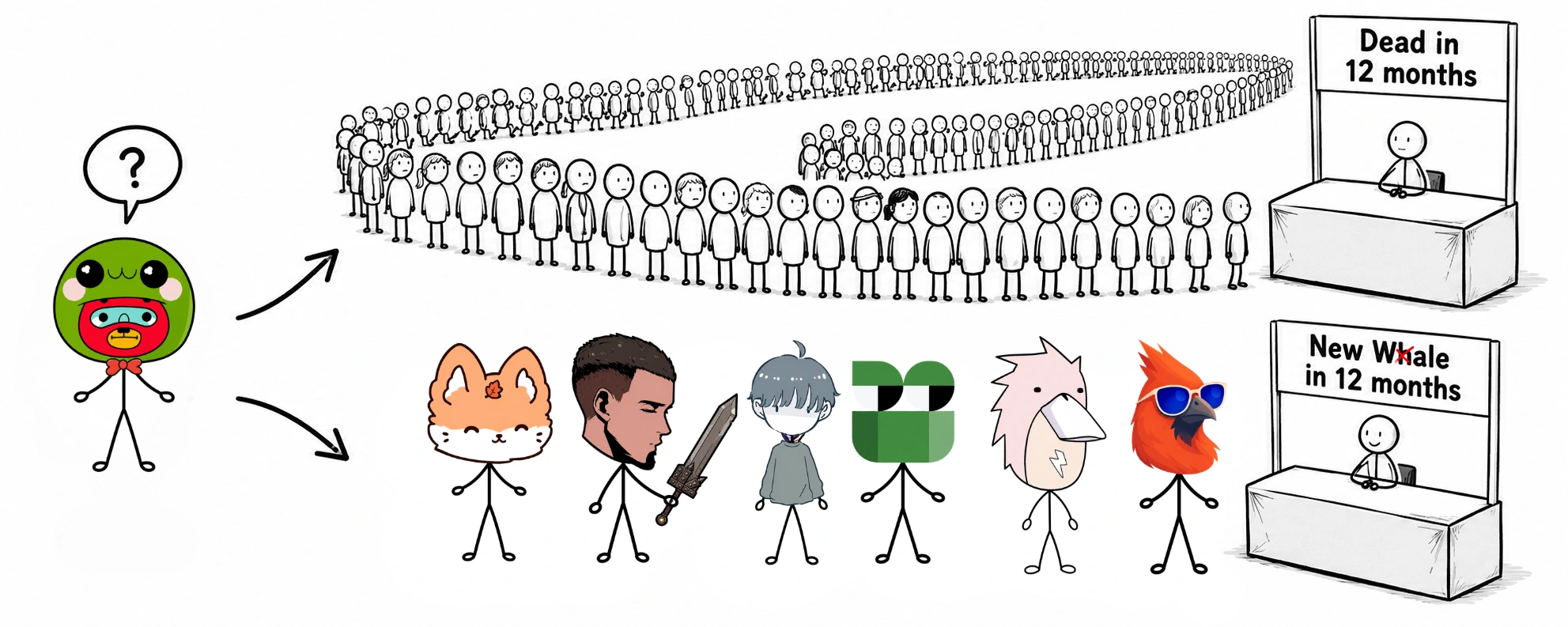
That's the thing about storytelling in Web3. It works differently here than anywhere else. This audience has been sold to constantly. By anonymous projects, by paid shills, by hype cycles that ended with empty wallets. They're trained to distrust by default.
When you show up and tell a real story, with real numbers and real vulnerability, it cuts through everything.
This is a breakdown of how to build a storytelling system for your personal brand on X. Four types of stories you need. The three elements that make any story work. And the paradox most creators get backwards.
Why Storytelling Works on a Skeptical Audience
Most Web3 content competes on information. Alpha, analysis, data, predictions. Everyone is trying to be the smartest voice in the room.
Stories compete on trust.
And trust, in this space, compounds. Someone who trusts you will follow your recommendation. Will stick around through a bear market. Will share your content because they want their network to know about you.
Alpha has a shelf life of hours. Trust lasts for years.
The data shows this clearly. Web3 founder content research found personal stories outperform promotional messaging by 10:1. Same audience. Same platform. Completely different result based on whether the content was trying to sell something or just telling the truth.
The reason: stories trigger a different response than information. Information gets evaluated. Stories get experienced. A reader processing information stays analytical and skeptical. A reader experiencing a story temporarily suspends that skepticism.
That window of suspended skepticism is where trust gets built.
The Three Elements Every Story Needs
A story without these three elements is just a sequence of events. With all three, it becomes something people remember.
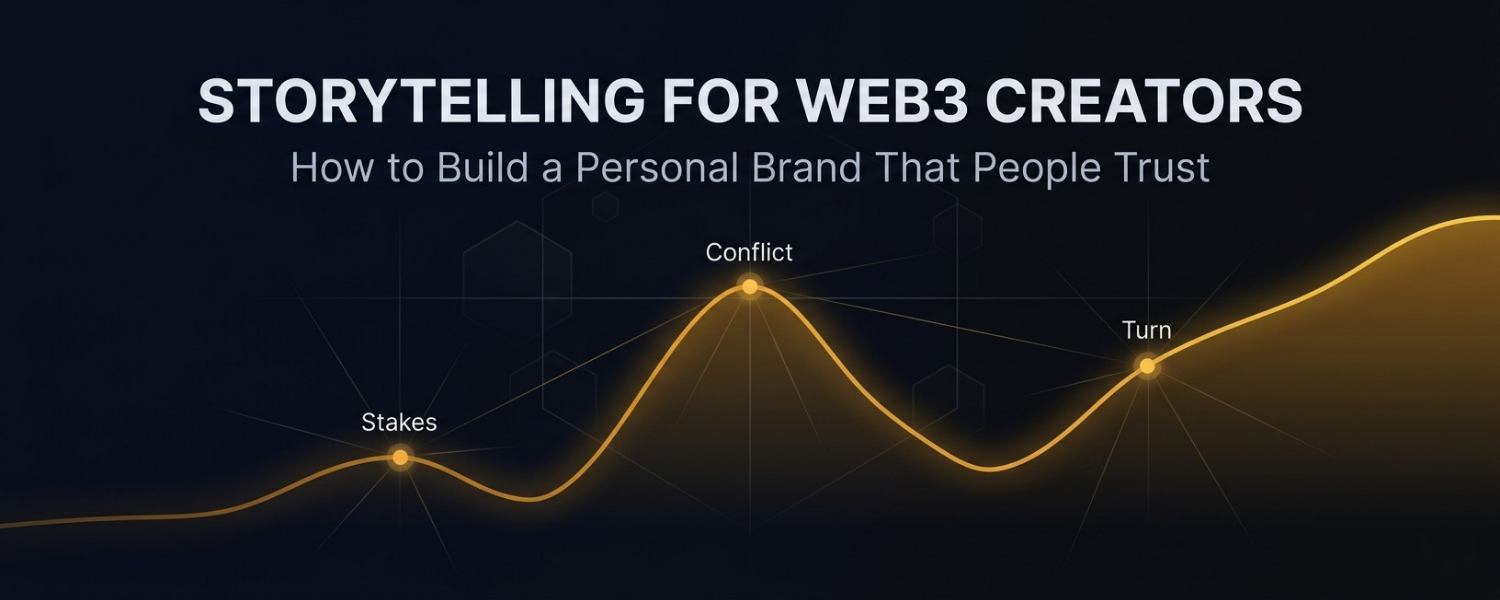
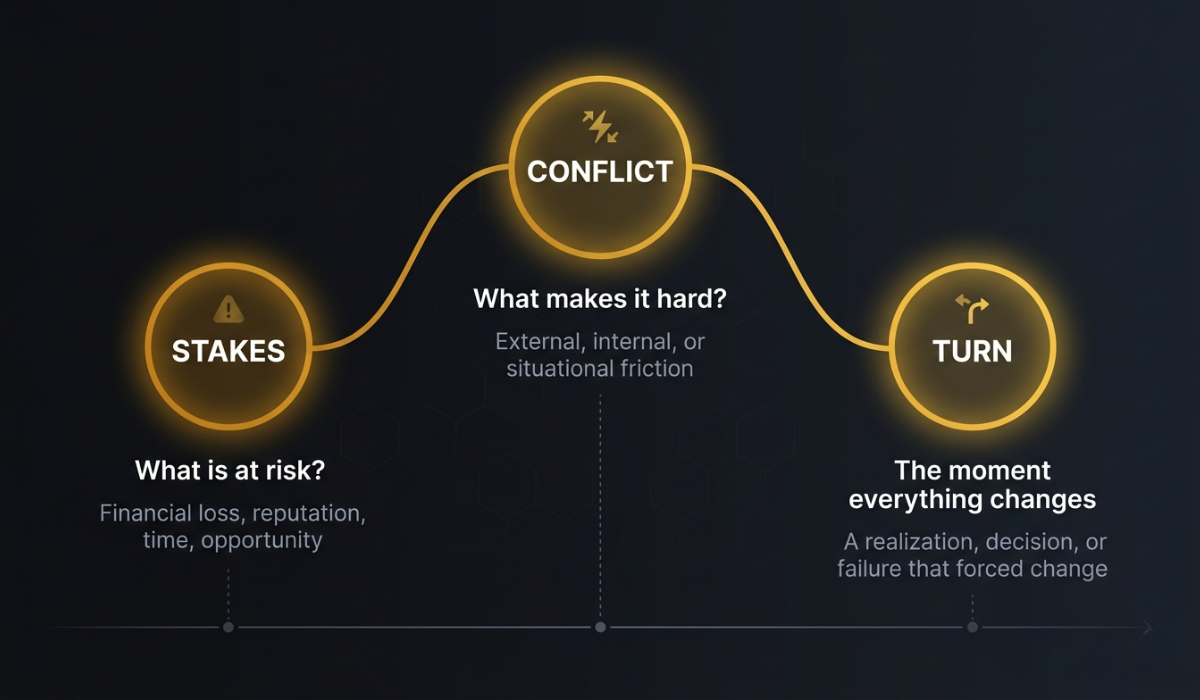
Stakes: What is at risk?
The reader needs to feel something is on the line. Financial loss, reputation, time, opportunity. Without stakes, there's no reason to care what happens next.
The more specific and personal the stakes, the more the reader feels them.
Conflict: What makes it hard?
Every good story has friction. Something working against the protagonist. External conflict (the market crashes, the algorithm changes, a project rugs), internal conflict (doubt, fear, the temptation to quit), or situational conflict (no time, no resources, no clear path forward).
Conflict is what creates the forward pull in a story. If everything goes smoothly, there's no tension and no reason to keep reading.
Turn: The moment everything changes.
One specific point where something shifts. A realization, a decision, a piece of information, a failure that forced a change. The turn is the heart of the story.
Build to it slowly. Never bury it in the middle. The best turns come late, just when the reader thinks they know where things are going.
The Four Stories Every Web3 Creator Needs
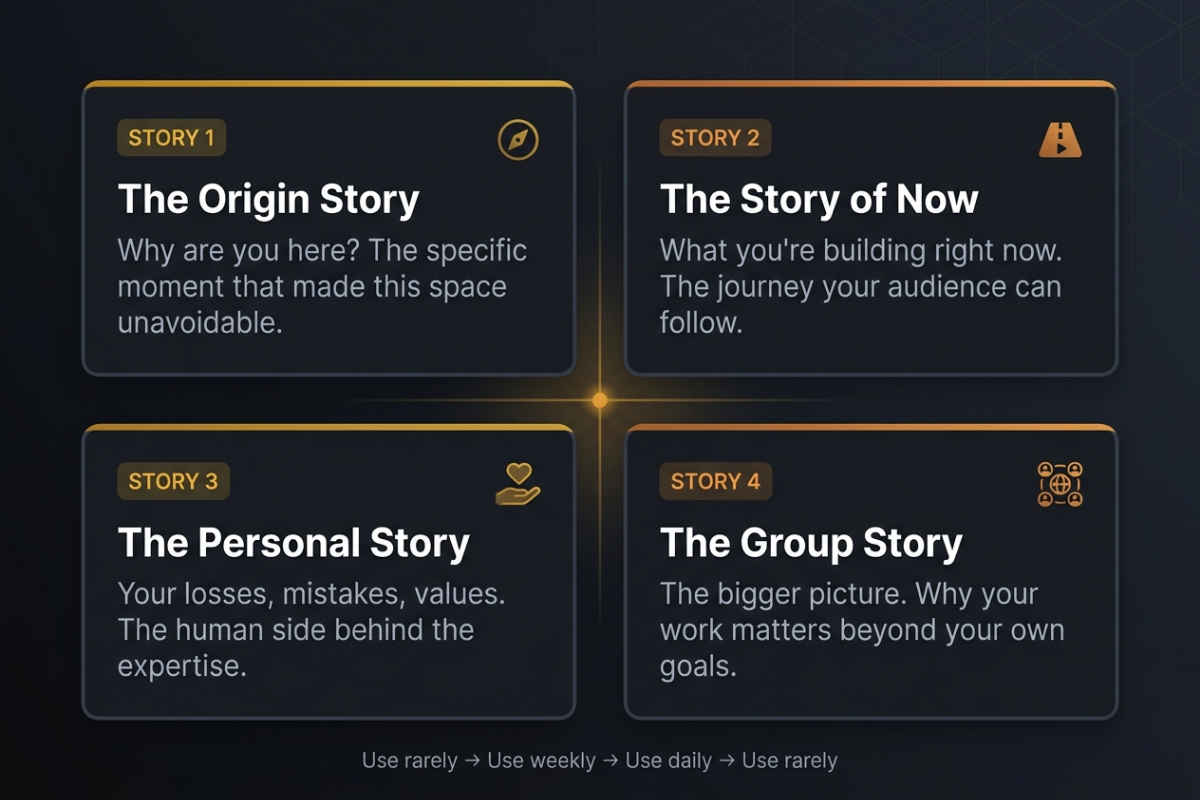
These four narratives work together. Each one serves a different trust-building function. You don't write all four in one post. You develop each one over time, in separate pieces of content.
Story 1
The Origin Story
Why are you here? Specifically.
The origin story answers the question every new follower is silently asking: why should I trust this person over the 10,000 other accounts talking about the same topics?
The answer is never credentials. It's the specific reason you couldn't stay away.
The difference: the weak version lists facts. The strong version shows a wound that never fully healed and a decision made because of it.
Your origin story doesn't need to be dramatic. It needs to be true. The specific moment, failure, or realization that made this space unavoidable for you. That's the story.
Story 2
The Story of Now
What are you building, learning, or doing right now? And how can someone join?
Where the Origin Story explains who you are, the Story of Now invites people to walk alongside you.
This is the story you tell in real time. The experiment you're running. The system you're building. The project that may or may not work.
It creates investment. A follower who understands what you're working toward becomes a stakeholder in your story. They want to see how it ends. They come back because they're following a journey, not just consuming content.
Story 3
The Personal Story
Your values. Your losses. Your mistakes. The human side that has nothing to do with being an expert.
This is the story type most creators in Web3 avoid. It feels risky. Showing weakness in a space that rewards confidence feels like a mistake.
It isn't.
Authentic vulnerability is a rare asset in crypto. Everyone is projecting confidence. Everyone is showing their wins. The moment you share a real loss with real numbers and real emotional honesty, you stand out immediately.
This doesn't mean oversharing or manufacturing drama. It means being willing to say: "This didn't work. Here's what it cost me and what I learned."
The specifics are what make it real. Vague admissions of failure feel performative. Specific ones feel honest.
Three types of Personal Stories that build trust on X:
The Loss Story: A specific financial, time, or reputation loss. What happened, how much, what changed because of it.
The Mistake Story: A decision you made that turned out to be wrong. No excuses. Just the error and the lesson.
The Value Story: A moment that showed what you actually believe. How you handled a hard situation. What you refused to compromise on.
Story 4
The Group Story
The bigger picture. Why what you're doing matters beyond your own goals.
This is the hardest story to tell well. It's easy to make it sound like a manifesto or a pitch. Done right, it's neither.
The Group Story places your individual work inside a larger context. It answers: why does it matter that creators in Web3 get better at content? Why does it matter that people learn to build an audience with integrity?
For a Web3 content creator, the Group Story might be about the kind of ecosystem being built: one where genuine value creation gets rewarded over shilling, where transparent creators outlast anonymous pump accounts, where the audience learns to tell the difference.
You're not just growing your own following. You're part of something changing how information moves through this space.
The Group Story should appear rarely. Once every few weeks at most. A creator who leads with Group Stories before establishing the other three comes across as a preacher. A creator who has shared losses, origins, and real-time work before adding Group Stories comes across as a leader.
Character Stories: The Short Form
Not every story needs to be a 10-tweet thread.
Character Stories are short pieces of content, sometimes a single tweet, that reveal how you navigate everyday decisions. They show your perspective, your values, your way of seeing things.
Examples:
These posts don't contain alpha. They don't teach frameworks. They just reveal a person making real decisions.
That revelation is what creates affinity. Followers who know how you think, what you value, and what you refuse to do are not just an audience. They're a community.
Aim for one Character Story per week. They take 5 minutes to write and compound over time more than almost any other content type.
The Transparency Paradox
Most creators think showing weakness will cost them credibility.
The opposite is true.
In a space full of projected confidence and anonymous accounts, showing a real loss with real numbers is a differentiator. It signals: this person is telling the truth. If they're honest about what went wrong, they're probably honest about what they're recommending too.
That's the paradox. Transparency about failure creates more trust than any highlight reel ever could.
The condition: the loss has to be followed by something real. What you learned. What changed. What you'd do differently. A loss post that's just "I lost money, feel sorry for me" doesn't build trust. A loss post that says "I lost 69%, here's exactly what I got wrong, here's how I think about it now" builds enormous trust.
The lesson is the bridge. Without it, the vulnerability is just exposure. With it, it becomes evidence of someone worth following.
Where to Start
Four stories. One system.
Most creators skip all four and just post information. That's why most creators have followers but not audiences.
Start with the Origin Story. Write it this week. Take your time. Make it specific. Don't publish the first draft.
Then add one Personal Story per week. A loss, a mistake, a value revealed. Keep it specific. Keep it true.
Let the Story of Now emerge from your daily work. If you're posting regularly, it's already happening. Just make it explicit occasionally.
Save the Group Story until you've built enough trust for it to land.
The SSS framework from our copywriting guide maps directly onto storytelling. Star is your origin. Story is the conflict and turn. Solution is what you built or learned.
Stories aren't a break from strategic content. They're the foundation everything else rests on.
What's Next in This Series
This is Article 4 of the Web3 Creator Playbook - a complete guide to content creation on X for crypto creators.
Article 1: copywriting frameworks. Article 2: hooks. Article 3: thread structure. This article: the trust layer underneath it all.
Next: What Makes Crypto Posts Go Viral on X in 2026 (The Algorithm Explained)
(The mechanics of distribution. Why some posts explode and most don't.)
Web3 Creator Playbook
- Part 1: The Copywriting Frameworks Every Web3 Creator Needs
- Part 2: How to Write Hooks That Stop the Scroll on Crypto Twitter
- Part 3: How to Write Crypto Twitter Threads That People Actually Finish
- Part 4: Storytelling for Web3 Creators: Build a Personal Brand That People Trust (this article)
- Part 5: What Makes Crypto Posts Go Viral on X in 2026 - coming soon
- Part 6–10: Engagement, AI Tools, Calendar, Ideas, Pillar - coming soon
Follow @pawnie_ on X to get each article as it drops. Or check the full series at web3lists.com/blog.