X Just Cut Payouts for Most Creators. Here's Who Wins Now
X quietly reduced payouts for aggregator-style accounts and pushed the platform harder toward original content. Almost two weeks later, the signal is clearer: reposting got weaker, original research got stronger, and Web3 creators should adjust now.
Context: I originally published this analysis on X on April 16, 2026, right after the change surfaced. This Web3Lists version is adapted on April 29, 2026, with the timing updated to match where we are now.
About two weeks ago, X quietly changed the rules.
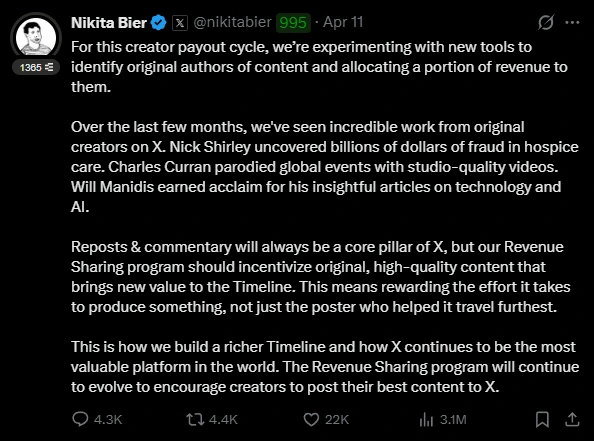
No announcement. No email. No warning. Just Nikita Bier dropping comments across the timeline explaining why a lot of creators suddenly saw their Revenue Share numbers cut.
If you missed that moment, you are not early anymore. But you are also not too late. The direction is clearer now than it was in the first 48 hours.
Let me break down what happened, who loses, who wins, and what type of content X is actually trying to reward now.
What Changed
Aggregator accounts, especially accounts built on reposted news, recycled clips, and copy-paste content from other platforms, had their payouts reduced to 60% in that cycle.
And according to Nikita's public comments at the time, more deductions were coming for repeat offenders and habitual bait posters.
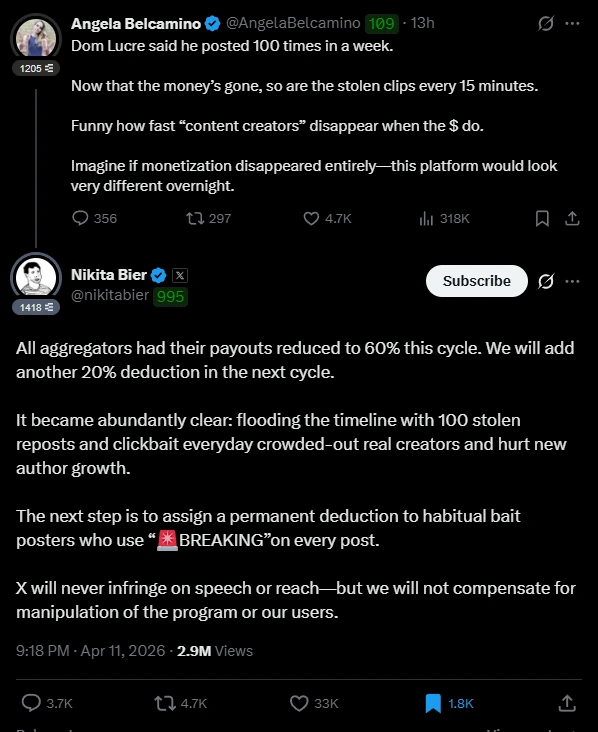
The mechanic itself was simple: Grok would analyze your post and determine whether the content likely originated somewhere else - TikTok, Instagram, YouTube, another X account, or another obvious source.
This was not presented as a reach penalty. It was a payout penalty. Your post could still perform. You just would not get paid as if the content were fully original.
That distinction matters because it reveals the real objective: X still wants viral content on-platform, but it wants the financial upside flowing back toward the originator rather than the recycler.
Who Got Hurt First
News aggregators
The classic "BREAKING:" accounts that post at industrial speed by scraping wires, headlines, and other creators. Huge volume, low originality. That model just became less profitable.
Clip accounts
Short viral clips lifted from TikTok, YouTube, or TV and repackaged for X. Plenty of engagement. Little original production. Exactly the category X appears to be targeting.
Habitual bait posters
Accounts that optimized for outrage framing, urgency language, and derivative posting loops. Even if they kept distribution, the payout economics got worse.
Low-effort quote-tweeters
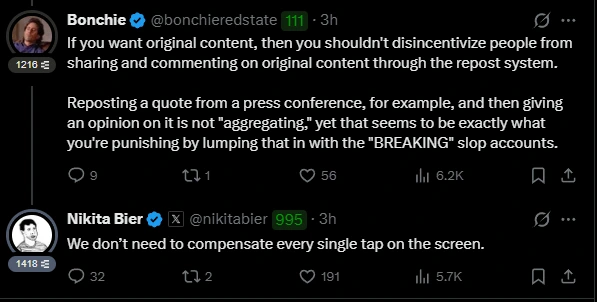
This is the messy middle. Commentary still matters, but a lazy quote-tweet with one sentence of surface opinion no longer looks like a safe monetization lane.
The gray zone is still graphics. Screenshots, charts, and derivative visuals sit in a murkier category than obvious ripped video. If you take an image already circulating and add almost nothing, that is clearly risky. If you transform it with real analysis, your position is stronger, but the boundaries are still not perfectly transparent.
The Real Problem With the Change
I want to be fair here: the policy made sense in theory.
Flooding the timeline with 80 recycled posts a day was crowding out real creators. New author growth was getting suppressed by high-volume accounts that were faster than everyone else, not more original than everyone else.
But two real criticisms still stand almost two weeks later.
First: if users start screenshotting instead of reposting to dodge the penalty, the original creator can still lose distribution in practice.
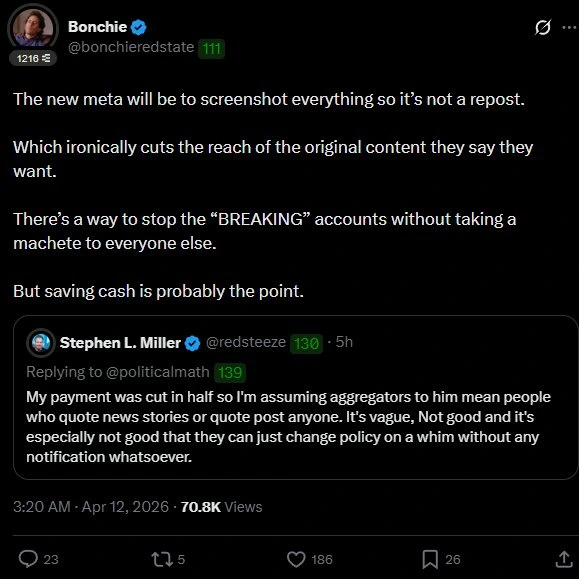
Nikita's answer at the time was basically: trust the system to figure it out.

Maybe that becomes true over time. But "the algorithm will figure it out" is still a lot of trust to extend to a system that was changed mid-April without public notice.
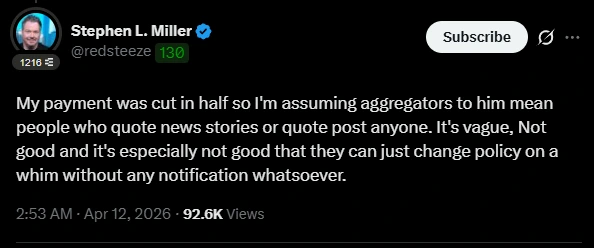
Second: X changed payout policy mid-cycle with no direct warning to creators.
That is a trust problem, not just a monetization problem. If your income stream can be reinterpreted with zero notice, creators stop optimizing for the rules and start optimizing for resilience.
Who Actually Wins Now
This is the more important side of the story.
When Nikita talked about the change, the examples he highlighted all pointed in the same direction: creators making something that did not exist before they posted it.
Original investigations. Original articles. Original parody production. Original reporting. Original insight.
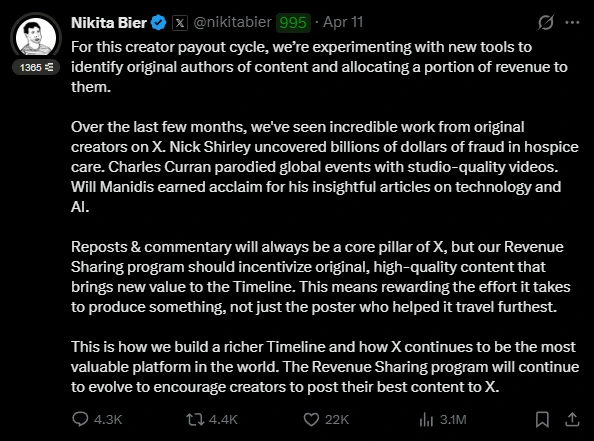
The new bar is not "did this get engagement?" The new bar is closer to: did you originate something meaningful?
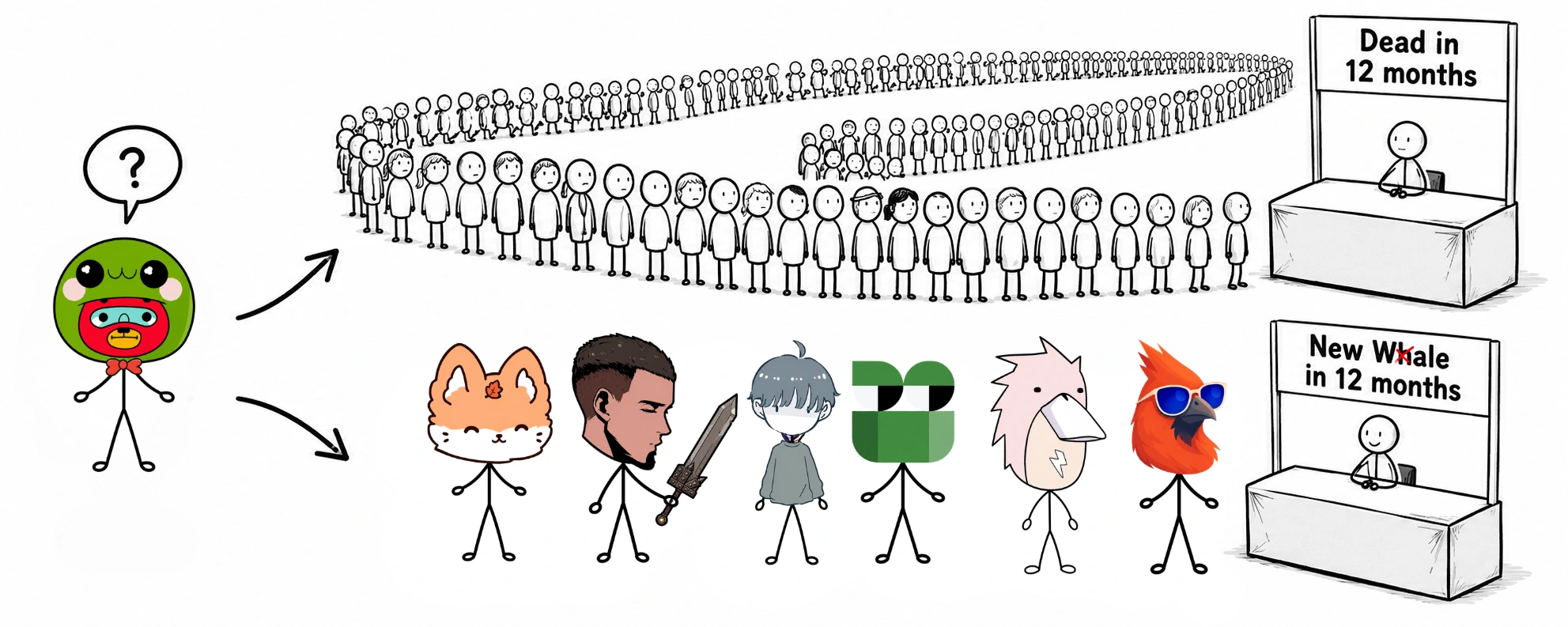
That matters a lot for Web3 creators, because our niche is full of recycled headlines, sentiment farming, and second-order commentary. There is suddenly more upside in being first with real work than in being fast with borrowed work.
What Content Gets Rewarded Now
1. Original video
Your face, your voice, your take. Even rough production has an advantage if the thinking is yours.
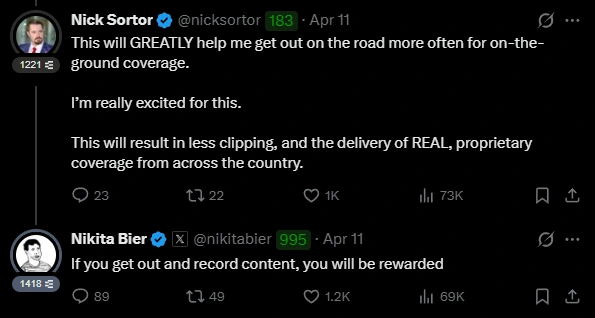
For crypto, that means on-camera breakdowns of on-chain data, protocol reactions, market structure takes, wallet flow analysis, and point-of-view explainers. If you are speaking into a lens and the analysis is yours, that is exactly the lane X wants.
2. Original research nobody else has posted yet
On-chain findings. Wallet tracking. protocol analysis. Governance proposal implications. Anything you surfaced before the rest of the timeline found it.
If you are first with something real, the quote-tweets, reposts, and screenshots increasingly orbit around your post instead of replacing it economically.
3. Original opinions on topics everybody is already discussing
Not "here is what happened."
More like: "here is what this means, here is the second-order effect, and here is why the timeline is reading it wrong."
This is where Web3 creators are still under-optimized. The niche has no shortage of hype or FUD. It has a shortage of grounded analysis with a real point of view.
4. Trend starters, not trend followers
If you create the frame, the meme, the thread structure, or the narrative hook that others start copying, X is clearly trying to make that origin point more valuable.
5. Content sourced from places other creators are not mining
Reddit. Discord. Telegram. GitHub repos. Governance forums. Niche docs. Buried dashboards. Originality is not only about writing something from zero. It is also about surfacing neglected information before the crowd sees it.
The Proof It Was Not Just Theory
Even early on, there were already examples pointing in the same direction: creators posting original tutorials, walkthroughs, and self-produced analysis were showing materially better outcomes than the recycled-content crowd.
That does not prove the system is perfect. It does show the system is directionally aligned with originality.
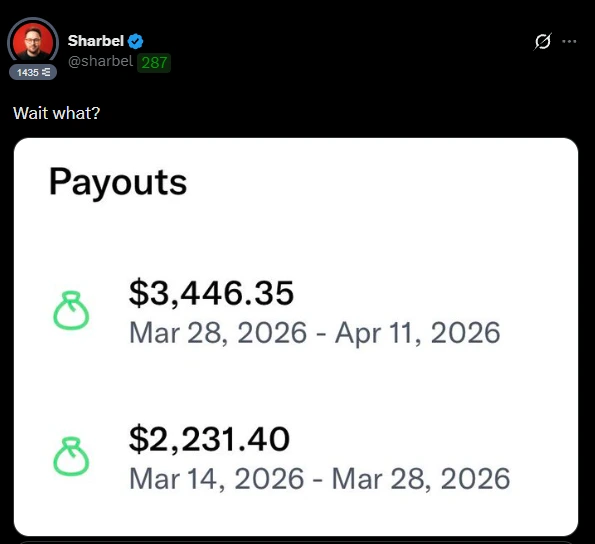
If you are building in Web3 and your content is based on original research, original takes, or original video, you are now competing in a cleaner lane than before. A portion of the aggregator noise got taxed out of direct competition with you.
The Part Most Creators Still Get Wrong
Most people treated this as a Revenue Share story. It was never only that.
For most serious creators, the direct payout is not the main economic engine anyway. The bigger game is what original content builds: trust, inbound deals, sponsorships, paid partnerships, consulting, audience leverage, and long-term brand equity.
Revenue Share is one income stream. Audience trust is the compounding asset.
If you were already building on original research and honest analysis before mid-April, you did not become obsolete when the rules changed. You became relatively more valuable.
The creators who panicked were usually the creators who had built for the program rather than the audience.
Those are different games. Only one of them compounds.
What Web3 Creators Should Actually Do
Quick framework
- Stop posting news that 50 other accounts will post in the same hour.
- Stop lifting clips from other platforms without meaningful transformation or commentary.
- Stop treating quote-tweets as a primary content strategy.
- Start building a research habit. Find one thing per week nobody else has written about.
- Start recording your actual opinions on video, even if the production is simple.
- Start writing threads that take a position instead of just summarizing what happened.
- Start mining Reddit, Discord, governance forums, and niche docs for material before it hits the X timeline.
- Accept that Revenue Share is one income stream, not the income stream.
The Bottom Line
X is trying to move more value toward creators who originate something real.
That is the right direction.
The execution was messy: no notice, mid-cycle changes, and legitimate gray areas around graphics, commentary, screenshots, and derivative content that still do not have perfectly clean boundaries.
But the direction is still right.
If your content strategy was "post fast and post a lot," the platform is actively making that model less attractive.
If your strategy is "find things nobody else found and say something real about them," you are now better positioned than you were before.
The real question: if every aggregator account disappeared from your niche tomorrow, would your content still stand out? Or were you mostly just moving faster than the noise?
That is the question X is increasingly paying creators to answer correctly.