How to Write Crypto Twitter Threads That People Actually Finish
Everyone says threads are dead. The data says otherwise. Threads are still the highest-ROI format on X for building authority and followers.
X launched long-form posts and articles. InfoFi platforms started scoring content, but threads never got properly tracked by most of them. So creators adapted. Short tweets for quick hits. Long posts and articles for depth. Thread culture faded.
But that created a gap. Fewer people writing threads means less competition. And threads still do something no single post can: they build sustained attention across 8-10 tweets, each one shareable on its own, each one pulling the reader deeper.
Most creators didn't stop writing threads because threads stopped working. They stopped because their thread architecture was bad. A lazy 10-tweet thread with no structure deserves to die. A well-built one still beats every other format for dwell time, follower conversion, and authority.
This is a full breakdown of how to structure threads that pull people from tweet 1 to the last.
Why Threads Still Dominate in Web3
Threads consistently outperform standalone tweets for authority building. Three reasons:
Dwell time. A reader who moves through 10 tweets spends far more time on your content than someone who reads a single post. The algorithm treats that sustained attention as a quality signal.
Multiple entry points. Every tweet in a thread is independently discoverable. If someone retweets tweet 6, their followers land in the middle of your thread, read back and forward, and find your profile. One thread creates 10 or more potential entry points into your work.
Semantic depth. The more you write about a specific topic in a single piece, the better Grok categorizes you as an authority on that topic. Threads let you build that depth in one sitting.
For Web3 creators specifically, threads are also where trust gets built. A single tweet can't show depth. A well-structured 8-tweet thread can turn a stranger into a follower. Combine thread structure with the PAS copywriting framework and you have a format that educates, persuades, and converts in one piece.
The Slippery Slide Rule
Every tweet must make the next tweet impossible to skip.
That's the whole rule. Every line, every tweet, every transition serves one purpose: keeping the reader in motion.
Think of a water slide. Once you're moving, gravity pulls you to the bottom. Good thread architecture works the same way. The reader starts at tweet 1 and the structure carries them forward without them consciously deciding to keep going.
This means every tweet needs a forward pull. A partial answer. An open loop. A raised question. Something that makes stopping feel like a loss.
The moment a tweet feels complete on its own, with no reason to continue, that's where readers exit. Keep things slightly unresolved. Deliver value while pointing ahead.
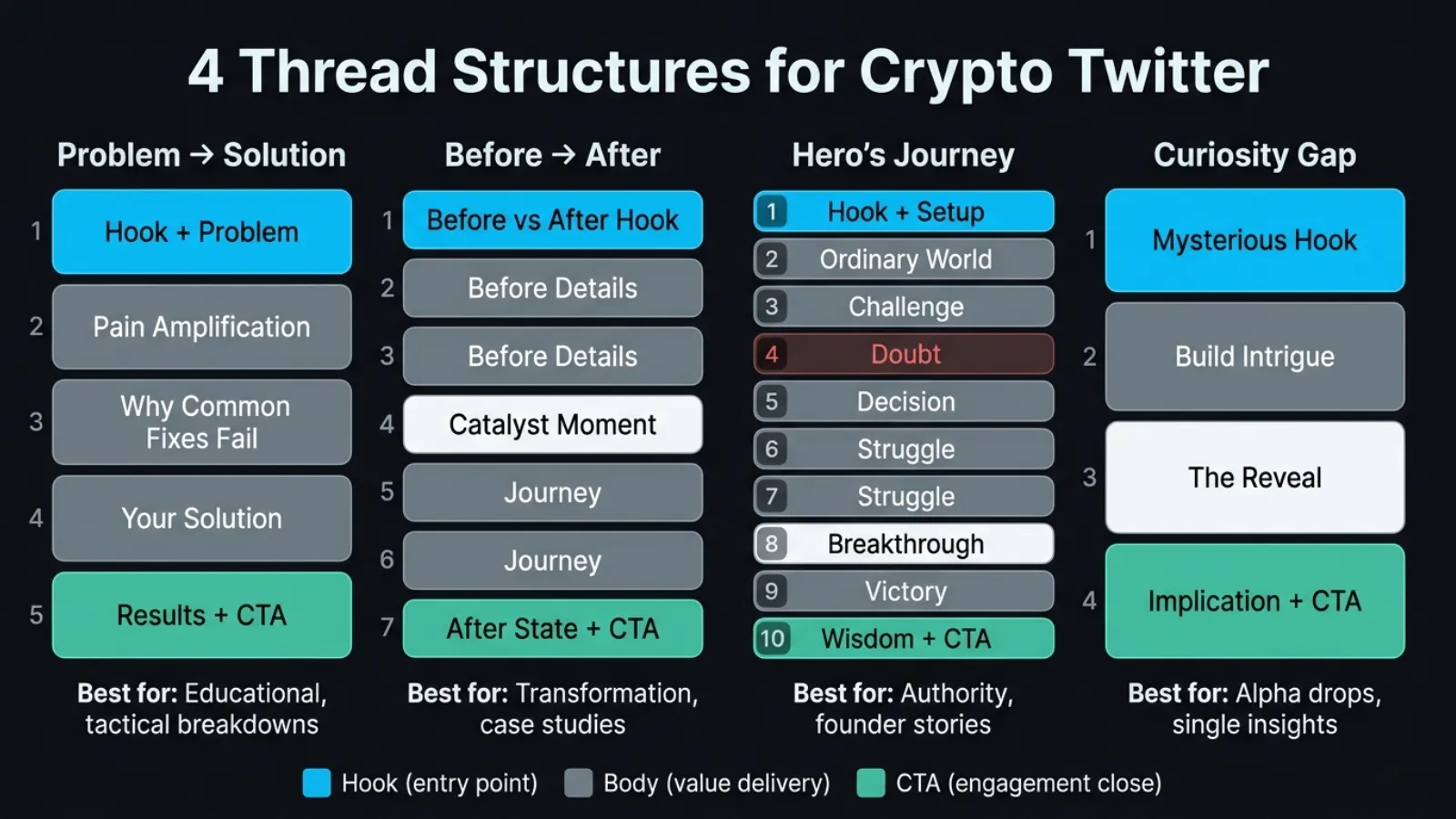
The 4 Thread Structures That Work
Structure 1
Problem → Solution (5 tweets)
Best for: educational content, tactical breakdowns, "here's what most people get wrong" posts
This is the most versatile structure for Web3. It maps directly onto the PAS framework from our copywriting guide, expanded across five tweets.
Tweet 1 (Hook + Problem): State the problem in a way that makes the reader feel it personally. Include a specific number or claim.
Tweet 2 (Pain Amplification): Make the problem feel bigger. Show what it's actually costing them.
Tweet 3 (Why Common Fixes Fail): Address what people usually try. Show why it doesn't work.
Tweet 4 (Your Solution): Give the actual answer. Be specific. Include steps or a framework.
Tweet 5 (Results + CTA): Show the outcome of applying the solution. End with an engagement prompt.
Structure 2
Before → After (7 tweets)
Best for: personal transformation, case studies, "I used to do X, now I do Y" content
This structure uses your own experience as the proof. No external data needed. The transformation is the evidence.
Tweet 1 (Before vs After Hook): Show the gap in one tweet. Make the after feel real and specific.
February 2026: 12.1K followers, posts averaging 5K impressions.
The difference was one thing. Thread ↓
Tweets 2-3 (Before Details): Expand on the before state. Include specific failures, frustrations, wrong turns. Make the reader recognize themselves in your struggle.
Tweet 4 (Catalyst): The moment everything changed. Be specific about what triggered the shift.
What I found contradicted almost everything I'd read about growth.
Tweets 5-6 (Journey): What you learned, tried, adjusted. Show real process.
Tweet 7 (After State + Lesson + CTA): Specific current results. One sentence summary of what changed. Open question for replies.
Structure 3
Hero's Journey Micro (10 tweets)
Best for: longer authority-building threads, founder story content, high-effort signature posts
This is the most powerful structure for building deep trust. It takes the classic Hero's Journey and compresses it into a 10-tweet thread.
Tweet 1 (Hook + Setup): Who you were and what was at stake
Tweet 2 (Ordinary World): The status quo before everything changed
Tweet 3 (Challenge Appears): The specific problem or obstacle
Tweet 4 (Doubt): Why you almost didn't try
Tweet 5 (Decision): The moment you committed
Tweets 6-7 (Struggle): What you tried, what failed, what you learned
Tweet 8 (Breakthrough): The specific insight or turning point
Tweet 9 (Victory): What changed. Specific results.
Tweet 10 (Wisdom + CTA): The lesson. What others can take from this.
The key element most people miss: the doubt in tweet 4. Showing vulnerability makes the breakthrough in tweet 8 feel earned. Without the doubt, the victory feels like luck.
Structure 4
Curiosity Gap (4 tweets)
Best for: short punchy threads, alpha drops, single-insight breakdowns
This structure opens a question and delays the answer as long as possible before delivering it.
Tweet 1 (Mysterious Hook): Open the gap. Promise something without revealing it.
It wasn't the hook. Wasn't the topic. It was something happening in tweets 3-5.
Thread ↓
Tweet 2 (Build Intrigue): Add complexity. Make the gap feel deeper.
Tweet 3 (The Reveal): Deliver the answer. This is the tweet people will screenshot and share.
Something that required the reader to slow down. Expand the image. Actually look.
That pause is a dwell time signal. The algorithm reads it as quality.
Tweet 4 (Implication + CTA): What this means for the reader. What they should do with the information.
Watch what happens to your completion rate.
What format do you use for your visuals?
Tension Techniques: The Engine Inside Every Structure
These six techniques work inside any of the four structures above. They're what keeps the slippery slide moving.
Partial reveals: "I found 3 things. I'll get to the third one at the end. It's the one that changed how I work every day."
Delayed answers: "More on that in a moment. First you need to understand why the algorithm changed in January 2026."
Raised questions: "But here's what nobody asks about this..." or "Then something unexpected happened at tweet 8."
Reversals: "The thing I thought was helping my reach was actually the cause of the plateau."
Escalating stakes: Small problem → gets worse → attempts fail → crisis point → breakthrough. Each tweet adds weight.
Open loops: End a tweet with a question or unresolved statement. The next tweet closes it. Then opens a new one.
Use two or three of these per thread. They're invisible to the reader but they're what creates the feeling of being pulled forward.
The Self-Contained Unit Rule
Every tweet in your thread should make sense if someone encounters it alone.
This sounds counterintuitive. If the tweets are self-contained, why would anyone read the whole thread?
Here's why: when a tweet is self-contained, it can be retweeted independently. Someone shares tweet 6. Their followers see it. It makes sense as a standalone insight. Some of those followers click through to read the whole thread. Some follow your profile.
A tweet that only makes sense in context of the 5 tweets before it can't be shared independently. You lose every potential entry point it could have created.
The formula: each tweet delivers one complete idea that has value on its own, plus a thread element that makes continuing feel worthwhile. Complete value + forward pull. Both at once.
The Pattern Interrupt
Put a visual in the middle of the thread. Tweets 3 or 4.
A chart. A screenshot. A simple graphic. Anything that requires the reader to slow down and look.
When someone expands an image, the algorithm registers it as a click signal. That click carries weight in the ranking formula. It also resets the reader's attention. Anyone who was half-reading suddenly has to focus to process the visual.
After the visual, the reader is more engaged than before. The second half of the thread gets more attention than the first half would have on its own.
You don't need a fancy graphic. A simple text-based chart created in Canva or a screenshot of real data does the job. The content matters more than the production quality.
The Final Tweet: Loop Closure
Most threads end weakly. A summary of what was covered, a generic "hope this helps," or a link dump.
The final tweet has one job: invite meaningful engagement.
The best technique: two-option framing. Give the reader a specific choice to react to.
Two-option framing reduces the friction for a reply to near zero. The reader doesn't have to think of something to say. They just pick a side. That reply is a high-weight signal for the algorithm. It also starts a conversation you can continue in the thread.
Avoid: "What did you think?" (too open), "RT if you found this useful" (feels like begging), "Follow for more" (converts nobody).
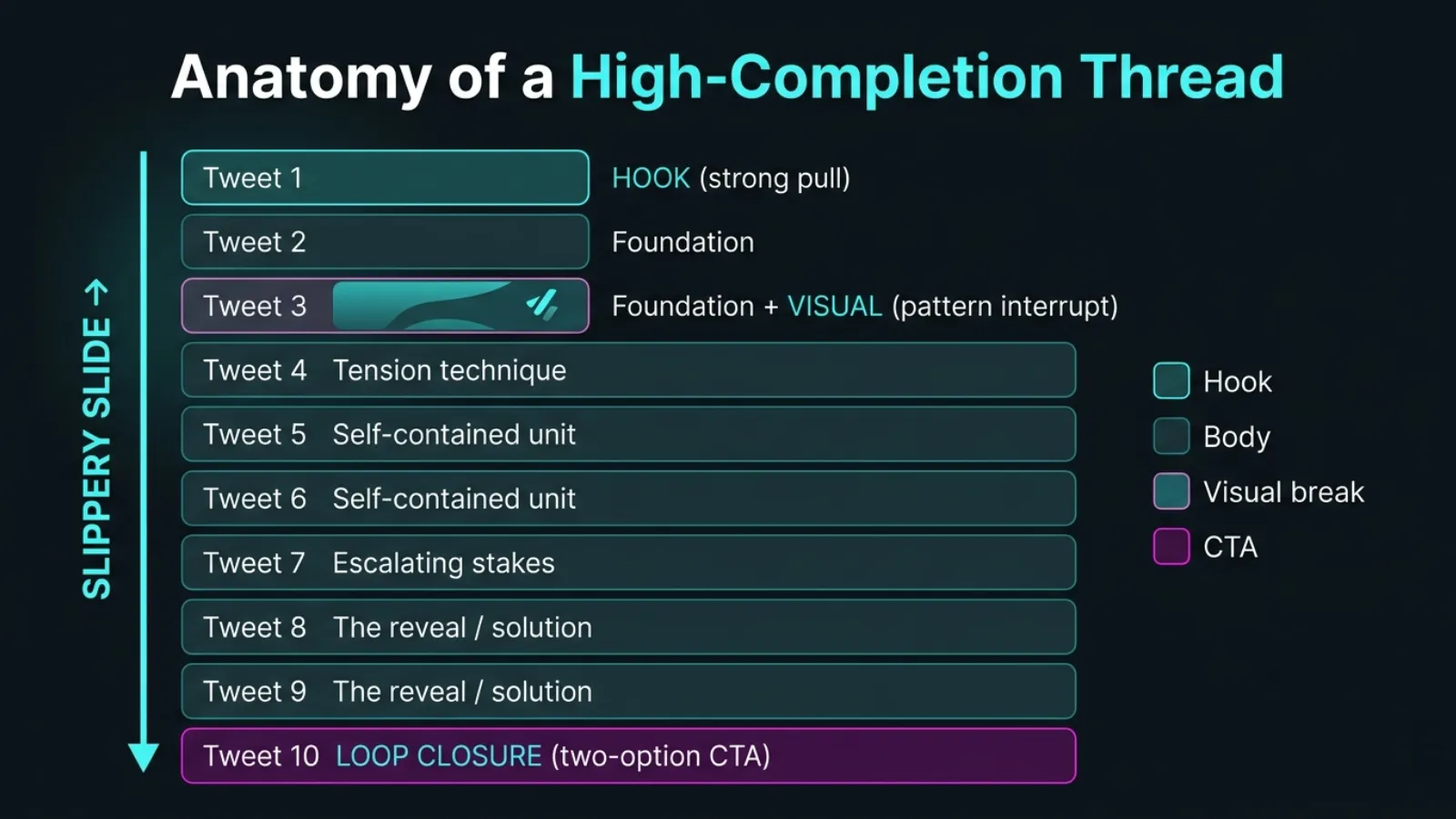
The Mistakes That Kill Threads
Tweets that are too long. The reader sees a wall of text at tweet 3 and scrolls past. Keep tweets under 200 characters when possible. Under 150 is better. Expand when you have something genuinely complex to explain.
No transitions between tweets. Each tweet ends abruptly. The reader has to work to follow the logic. Use transition phrases: "Here's where it gets interesting...", "The reality is...", "This is where most people stop."
Front-loading all the value. Tweets 1-3 are excellent. Tweets 7-10 are padding. Distribute value evenly. Save one strong insight for the second half of the thread.
Forgetting the visual. A 10-tweet all-text thread loses attention in the middle. The pattern interrupt at tweets 3-4 is not optional.
Weak final tweet. The thread ends and the reader has nowhere to go. No question, no debate frame, no reason to reply. All that dwell time and engagement with no conversion to a real interaction.
Building Your First Structured Thread
Pick one structure. Commit to it for the thread.
Use Problem → Solution if you're explaining something tactical.
Use Before → After if you have a personal transformation story.
Use Curiosity Gap if you have one sharp insight to build toward.
Use Hero's Journey for signature content you want to define your brand.
Write the hook first. Apply the hook techniques from our previous guide. Then fill in the structure tweet by tweet.
Check each tweet: does it deliver value on its own? Does it create forward pull? If both answers are yes, move to the next one.
Check the whole thread: does tweet 3 or 4 have a visual? Does the final tweet invite a specific response?
That's the full system. It sounds like a lot until you've done it once. Then it becomes the only way you write.
What's Next in This Series
This is Article 3 of the Web3 Creator Playbook - a complete guide to content creation on X for crypto creators.
The copywriting frameworks guide gave you the structures. The hooks guide gave you the openers. This article gave you the architecture between them.
Next: Storytelling for Web3 Creators - How to Build a Personal Brand That People Trust
(The framework for the 10-20% of your content that builds the deepest trust over time.)
Web3 Creator Playbook
- Part 1: The Copywriting Frameworks Every Web3 Creator Needs
- Part 2: How to Write Hooks That Stop the Scroll on Crypto Twitter
- Part 3: How to Write Crypto Twitter Threads That People Actually Finish (this article)
- Part 4: Storytelling for Web3 Creators: Build a Personal Brand That People Trust
- Part 5–10: Viral Mechanics, Engagement, AI Tools, Calendar, Ideas, Pillar - coming soon
Follow @pawnie_ on X to get each article as it drops. Or check the full series at web3lists.com/blog.