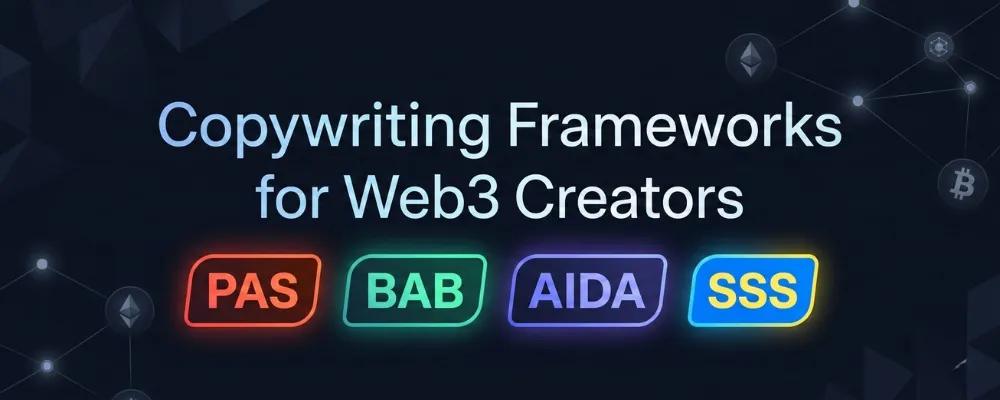
The Copywriting Frameworks Every Web3 Creator Needs (PAS, BAB, AIDA, SSS)
Four copywriting frameworks changed how I write on X. They didn't change my topics or the effort I put in. They changed the architecture around every idea.
I was posting decent content for months and getting flat results. Then I learned PAS, BAB, AIDA, and SSS. The structure changed. So did the numbers.
This is a breakdown of all four. With real crypto examples for each. And a simple guide for when to use which one.
Bookmark this. You'll come back to it.
Why Web3 Audiences Are Different
Before the frameworks, one thing you need to understand.
Crypto Twitter is the most skeptical audience on the internet. They've been rugged. Scammed. Promised 100x by anonymous devs who disappeared. They've seen every manipulation tactic in the book.
Traditional marketing tricks don't work here.
Frameworks work because they're structures, not tricks. When applied honestly, they feel like respect. You're naming real problems. Showing real proof. Being direct about what you offer.
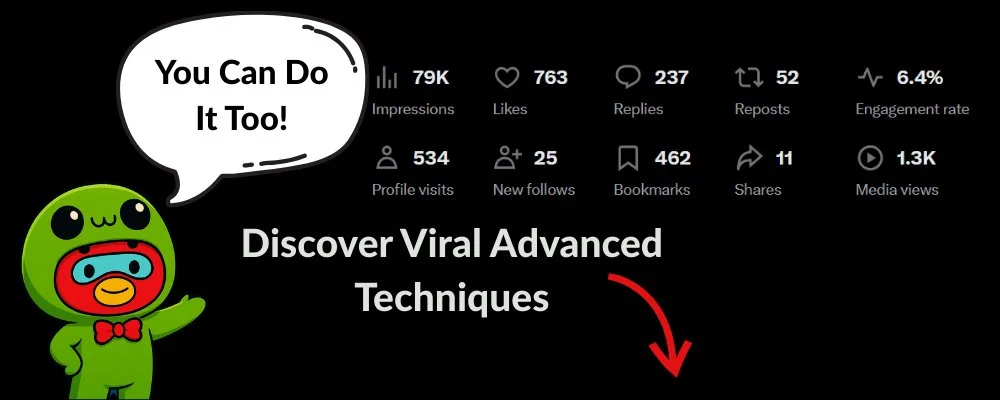
One crypto creator tracked their engagement shift after switching from random posting to framework-based structure. Same topics. Same posting frequency. Engagement went from 0.8% to 12%.
The content didn't change. The architecture did.
Here are the four frameworks that matter.
4 Copywriting Frameworks for Crypto Twitter
PAS: Problem → Agitate → Solution
Best for: educational threads, pain-point content, niche takes, anything that starts with "most people get this wrong"
PAS is the strongest framework for crypto Twitter. Full stop.
Why? Your audience already has the pain. They're carrying it every day. You're naming it, which is a completely different dynamic than traditional sales copy.
How it works
You're posting 3–5 times a day.
Your impression graph is still flat.
Everyone says "post more." You are posting more.
Something doesn't add up.
Here's what's actually happening.
The X algorithm has an Author Diversity Scorer.
Post 10 times in a row and your 10th post is nearly invisible.
You're not just wasting time. You're actively hurting your reach.
Fix: space posts minimum 2–3 hours apart.
Your first post of the day gets the highest score.
One great post beats five mediocre ones every time.
Notice what happened. By Tweet 2, the reader is nodding along. By Tweet 3, they're sold before you even finish the sentence.
PAS works because you validate before you offer. That's the sequence crypto audiences respond to.
BAB: Before → After → Bridge
Best for: personal transformation stories, case studies, product demos, anything where you can show "I was here, now I'm here"
BAB is the framework that makes you the proof.
You don't need external data. You don't need credentials. You just need an honest before and after, with a specific bridge connecting the two.
How it works
800 followers. Posting daily for 6 months. Every post getting 300–500 impressions.
I knew my content was decent. But I was invisible.
11.7K followers today. Individual posts hitting 50K+ impressions.
500+ consecutive days of showing up.
The ideas stayed the same. The structure changed.
Specific frameworks for every type of post.
Here's exactly what changed ↓
The bridge is everything. Without it, BAB is just bragging.
With it, you become a case study others want to follow. In Web3, where trust is the scarcest resource, showing your own transformation builds more credibility than any credential.
AIDA: Attention → Interest → Desire → Action
Best for: promotional posts, growth content, anything you want people to click or act on
AIDA is the classic copywriting framework. It's also the most misused one.
Most people apply it to pure sales content and wonder why it feels spammy. AIDA works best when the Action points to something genuinely useful: a thread, a resource, a free tool.
How it works
The X algorithm shows 50% of your feed from accounts you don't follow.
That means half the platform is accessible to you, even with 500 followers.
The catch: you have to cross the velocity threshold in the first 60 minutes.
Imagine your best content reaching 10K people who've never heard of you.
Relevant audience. Real follows. No paid promotion.
I wrote the full breakdown of how this works.
Including the exact signals that trigger out-of-network distribution.
Link below.
Short. Clean. Every line earns the next one.
AIDA is your conversion framework. Use it when you have somewhere to point people.
SSS: Star → Story → Solution
Best for: personal brand building, founder narratives, authority content, anything that needs long-term trust
SSS is the most underused framework on crypto Twitter.
Everyone is sharing alpha. Data. Takes. Nobody is sharing their actual story. That gap is your opportunity.
How it works
In 2022 I was a regular person with too much time, a spreadsheet, and a bear market eating my savings.
Lost 60% of my portfolio. Pure decision-making failure.
Random FOMO entries. Panic exits. No system. No framework.
I spent the next 12 months studying what the people who survived bear markets had in common.
Every post I write now is something I tested before I wrote about it.
No theory. No guru stuff. Just what actually worked, for me and the 11K+ people who follow along.
One study of Web3 founder content found that personal stories outperform "buy/follow this" messaging by 10:1.
That ratio makes sense. People follow people. SSS builds the person behind the content.
Which Framework for Which Goal?
| Framework | Use when… | Primary emotion |
|---|---|---|
| PAS | Addressing a frustration your audience already feels | Frustration |
| BAB | Sharing a before/after story or case study | Hope |
| AIDA | You want people to click, follow, or take a specific action | Curiosity |
| SSS | Building long-term trust and personal authority | Trust |
Which Framework to Use When
Still unsure after the table? Ask one question: "What's the primary emotion I want to trigger?"
- Frustration at a problem → PAS
- Hope for transformation → BAB
- Curiosity about a solution → AIDA
- Trust in a person → SSS
The most effective crypto creators mix all four. Different posts, different goals, different frameworks. Nothing is random. Every post has an architecture.
The #1 Mistake When Using Frameworks
Frameworks don't save bad content.
This is the trap. You learn PAS, apply it to a generic problem nobody actually cares about, get no results, conclude "frameworks don't work."
They do work. The framework is a structure. The content still has to be real.
What failure looks like
"You're losing money in crypto" (Problem) → "It keeps you up at night" (Agitate) → "Here's my system" (Solution)
The problem is generic. The agitation is vague. The solution is unnamed. The reader felt nothing because you said nothing.
The most dangerous version of this mistake: using frameworks as a template for AI-generated filler. Crypto audiences have seen thousands of posts. They detect mechanical content in seconds. And when they do, the credibility damage is worse than any bad take could cause.
Framework + generic filler = credibility collapse.
The framework is the container. What you put inside it still has to matter.
Where to Start
Four frameworks. Four different goals.
- PAS — pain-point content and educational threads
- BAB — personal transformation and case studies
- AIDA — promotional posts and conversion content
- SSS — personal brand and long-term authority building
You don't need to master all four at once.
Pick one. Apply it to every post you write for the next two weeks. See what changes. Then add the next one.
Most creators skip this step. They read about frameworks, feel motivated for 20 minutes, then return to winging it. Nothing changes.
Don't be most people.
Pick your first framework. Write your first post with it today. Reply to @pawnie_ with what you chose — I'll give you honest feedback.
What's Next in This Series
This is Article 1 of the Web3 Creator Playbook — a complete guide to content creation on X for crypto creators.
Web3 Creator Playbook
- Part 1: The Copywriting Frameworks Every Web3 Creator Needs (this article)
- Part 2: How to Write Hooks That Stop the Scroll on Crypto Twitter
- Part 3: How to Write Crypto Twitter Threads That People Actually Finish
- Part 4: Storytelling for Web3 Creators: Build a Personal Brand That People Trust
- Part 5–10: Viral Mechanics, Engagement, AI Tools, Calendar, Ideas, Pillar — coming soon
Follow @pawnie_ on X to get each article as it drops. Or check the full series at web3lists.com/blog.