7 Growth Strategies for the New X Algorithm
I spent 5 hours analyzing X's open-source algorithm code with Claude. What I found contradicts almost everything "growth gurus" have been telling you.
What will you learn?
- What works
- What doesn't work
- What to avoid
- What not to avoid
BTW. My predictions from recent months regarding the algorithm have come true, so if you've read my previous posts, you'll definitely find many similarities.
The Day Everything Changed
X updated their public algorithm repository. New architecture. New ranking system. Complete overhaul.
Hundreds of posts on this topic have already started to appear (articles too), so I decided to write something myself and test the algorithm in practice at the same time.
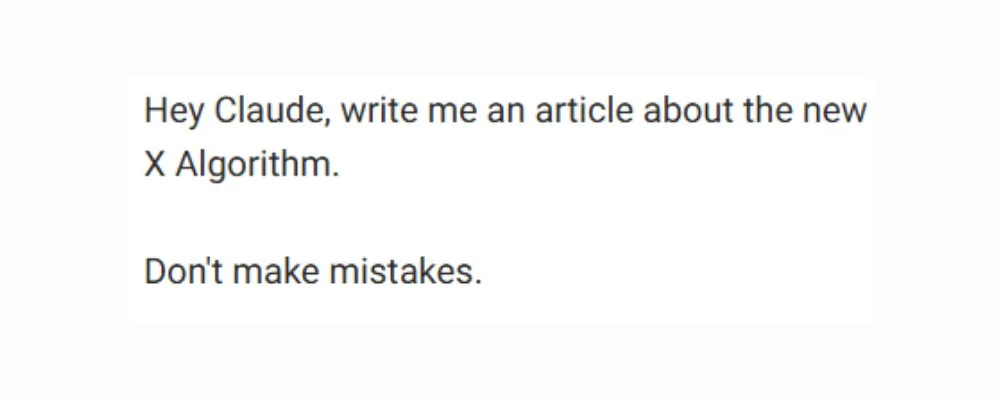
So I did what any obsessive person would do. I downloaded the entire algorithm and uploaded it to Claude.
What I found?
The algorithm doesn't work how you think it does.
- All those "post at 8 AM" tips? Partially wrong.
- "Engagement pods boost your reach"? The algorithm can detect them.
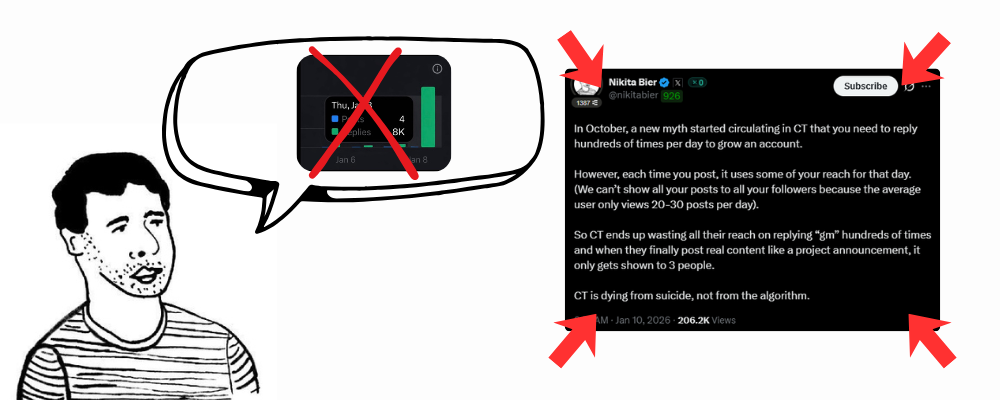
- "Just post more content"? Actually penalized now.
First, a little theory, then only practice.
Phoenix Ranking: The Brain Behind Your Feed
The new system runs on something called Phoenix Ranking.
And it's powered by Grok-1 - the same AI model from xAI.
Why does this matter?
Because there are NO manual rules anymore.
- No human said "likes are worth X points"
- The AI learned everything from billions of real interactions
- It watches what people actually do. Then predicts what they'll do next.
That's a fundamental shift.
Stage 1: Candidate Selection
Two sources feed your timeline:
- Thunder (In-Network): Posts from accounts you follow. Stored in RAM. Lightning fast retrieval.
- Phoenix Retrieval (Out-of-Network): Posts from accounts you DON'T follow. Found through AI similarity matching.
About 50% of your feed comes from people you've never followed.
That's massive for growth. Half your potential audience doesn't even know you exist yet.
Stage 2: Phoenix Ranking
Every candidate post gets scored independently.
The AI predicts 18 different actions you might take. Then multiplies each probability by a weight.
- Positive actions = positive score
- Negative actions = negative score
- Final score determines if you see the post
Simple concept. Complex execution.
The 18 Actions That Control Your Reach
Here's what the algorithm is actually tracking.
Positive Signals (boost your ranking)
| # | Action | Weight |
|---|---|---|
| 1 | Like | High |
| 2 | Retweet | Highest distribution |
| 3 | Reply | High (quality conversation) |
| 4 | Quote Tweet | Medium-high |
| 5 | Click on post | Medium (interest signal) |
| 6 | Share | Medium |
| 7 | Share via DM | Medium (strong signal) |
| 8 | Copy link | Medium (intent to share) |
| 9 | Click on profile | Medium (curiosity) |
| 10 | Expand image | Low |
| 11 | Video Quality View (VQV) | High |
| 12 | Dwell time | Medium |
| 13 | Continuous dwell | Medium |
| 14 | Click quoted tweet | Low |
| 15 | Follow author | Highest positive signal |
Negative Signals (tank your ranking)
| # | Action | Penalty |
|---|---|---|
| 16 | "Not interested" | Direct rejection |
| 17 | Block author | Severe penalty |
| 18 | Mute author | Severe penalty |
| 19 | Report | Most severe penalty |
The AI predicts how likely each action is. Multiplies by importance. Adds them up.
One block can erase ten likes.
One report can destroy a hundred impressions.
The negative actions hit HARD.
What This Means For Your Strategy
Let me break down what actually works now.
Strategy 1: Optimize for Retweets, Not Likes
Likes are easy. Everyone double-taps and scrolls.
Retweets are commitment. Someone is saying "I want my followers to see this."
The algorithm knows the difference.
What to do:
- Create content people want to be associated with
- Make it easy to share (clear takeaway, not too controversial to embarrass)
- End with shareability in mind ("Send this to someone who needs it")
- Lists and threads get retweeted more than single tweets
Strategy 2: Maximize Dwell Time
The algorithm tracks how long people look at your post.
Not just clicks. Actual attention.
If you've read our article on Nikita Bier's tips, you already know dwell time matters more than raw engagement metrics.
What to do:
- Write longer, valuable content (threads/articles win here)
- Use storytelling - people read to the end of stories
- Add images and charts - increases viewing time
- Use line breaks for readability
- Create "wait, what?" moments that make people pause
Strategy 3: Video Has a Secret Bonus
There's a special metric called VQV - Video Quality View.
It triggers when someone watches your video past a certain threshold (likely 2-5 seconds).
VQV has its own weight in the ranking formula.
What to do:
- Hook in the first 2 seconds (stop the scroll)
- Keep videos short and valuable (15-60 seconds optimal)
- Add captions - most people watch without sound
- Cliffhangers in the middle increase watch time
Strategy 4: The Author Diversity Scorer Will Punish You
This is huge. And nobody talks about it.
The algorithm has a built-in spam detector called Author Diversity Scorer.
Here's how it works:
- Your first post: 100% score
- Your second post: score × decay factor
- Your third post: score × decay²
- And so on...
Post 10 times in a row? Your 10th post is basically invisible.
What to do:
- Space your posts (minimum 2-3 hours apart)
- Quality over quantity (one great post > ten mediocre ones)
- Your FIRST post of the day is your most important
- Stop the posting marathon mentality
Strategy 5: The First 30 Minutes Are Critical
Phoenix Retrieval looks at early engagement signals.
If your post doesn't get traction in the first 30-60 minutes, it's essentially dead for out-of-network distribution.
What to do:
- Post when YOUR audience is online (not generic "best times")
- Engage with comments immediately - every reply is another signal
- Have your hook absolutely nailed - no weak openings
- Warm up your audience with engagement before posting
Strategy 6: Out-of-Network Is Your Growth Engine
Remember: 50% of feeds come from accounts people don't follow.
This is how accounts explode. Phoenix Retrieval finds your content and shows it to strangers.
What to do:
- Create evergreen content (not just news reactions)
- Broader appeal helps (ultra-niche limits OON reach)
- Engage with bigger accounts in your space (you become "part of the conversation")
- Early engagement is key - it signals to Phoenix that you're worth distributing
Strategy 7: Never Trigger Negative Actions
One block = approximately 10 likes erased.
The negative weights are brutal.
What to do:
- Avoid pure clickbait (high clicks + "not interested" = net negative)
- Don't be toxic (blocks and reports destroy accounts)
- Don't spam (triggers mutes)
- Stay authentic (fake engagement patterns get detected)
The Anatomy of a 2026 Viral Post
Based on the algorithm structure, here's what viral posts need:
Layer 1: The Hook (first 1-2 lines)
Stops the scroll. Creates curiosity or emotion.
The algorithm sees: people pausing = dwell time signal
Example: "I just lost $100K and it was the best decision of my life..."
Layer 2: Value / Entertainment / Emotion
Delivers on the hook promise.
The algorithm sees: continued reading = sustained dwell
You're teaching, entertaining, inspiring, or (carefully) provoking.
Layer 3: Call to Action
Explicit or implicit ask for engagement.
The algorithm sees: replies, retweets, likes = positive signals multiplying
"What do you think?" or "Quote tweet if you agree" or "Tag someone who needs this"
Layer 4: Shareability
People want to retweet things that make them look good.
The algorithm sees: retweet = highest distribution weight
Not too controversial. Not embarrassing to share. Represents who they want to be.
For a deeper dive into the psychology that makes content spread, check out our article on The Hidden Psychology Behind Viral Content.
What To Avoid (Red Flags)
The algorithm penalizes these patterns:
Clickbait that disappoints
High click rate + immediate "not interested" = net negative score.
The algorithm learns: this creator wastes people's time.
Engagement pods
Same accounts. Same timing. Artificial patterns.
Phoenix learns real human behavior. Fake engagement looks different.
Posting only external links
X wants users to stay on X.
Links probably have lower weight. Native content wins.
Copy-pasting viral posts
Duplicate detection is real.
The algorithm filters copies. Plus, users already saw the original.
Being too corporate
Personal opinions > brand speak.
Human > company.
The algorithm was trained on human interactions. It knows what authentic looks like.
The Golden Rule
Create content that generates positive actions while avoiding negative ones.
Be consistent. Be valuable. Be human.
That's it! No secret hack. No magic trick.
The algorithm is just trying to show people content they'll genuinely enjoy. If you create genuinely enjoyable content, you're aligned with the algorithm.
If you're trying to game it, you're fighting a Grok-1 powered AI that learned from billions of interactions. Good luck with that.
My Predictions for 2026-2027
Based on the current architecture:
- Video will get even more weight - VQV is already special, expect more
- Long-form content rising - dwell time rewards depth
- Community features expanding - reply engagement might increase in weight
- Quality over quantity accelerating - Author Diversity Scorer is just the start
- Personalization getting deeper - the AI learns better over time
The Real Lesson
The algorithm isn't your enemy.
It's a system trying to match good content with interested people.
If you're creating real value, it's your ally.
If you're trying to trick it, you've already lost.
The best creators in 2026 won't be the ones who "cracked the algorithm."
They'll be the ones who understood their audience deeply and delivered consistently.
The algorithm just amplifies what's already working.
Your Move
Here's what to do with this information:
- Audit your posting frequency - are you triggering Author Diversity Scorer?
- Check your first-hour engagement - is your timing actually optimal?
- Review your negative signals - are you getting blocks/mutes you don't know about?
- Optimize for retweets - not just likes
- Invest in dwell time - longer, more valuable content
If this helped you understand how X actually works now - Retweet it.
Someone in your network is still following 2024 advice...
They need to see this.
Analysis based on X's public algorithm repository, January 2026. The algorithm is dynamic and may change. Exact weights are not publicly disclosed - relative importance is inferred from architecture analysis.
This article was written by AI based on my own system, and I am not ashamed of it.
Follow and notifications turned on?
If you don't want to miss out, you can join my Telegram channel or Discord. I'll post announcements there when new articles are published.