How to Write Hooks That Stop the Scroll on Crypto Twitter
The first line is the only line that matters. Get it wrong and nobody reads the rest. Get it right and everything else gets pulled along behind it.
I analyzed 200+ viral posts from Web3 creators. Every single one had the same thing in common.
The first line made stopping feel inevitable.
That's the hook. And it's the most important sentence in anything you write. Get it wrong and nobody reads the rest. Get it right and everything else gets pulled along behind it.
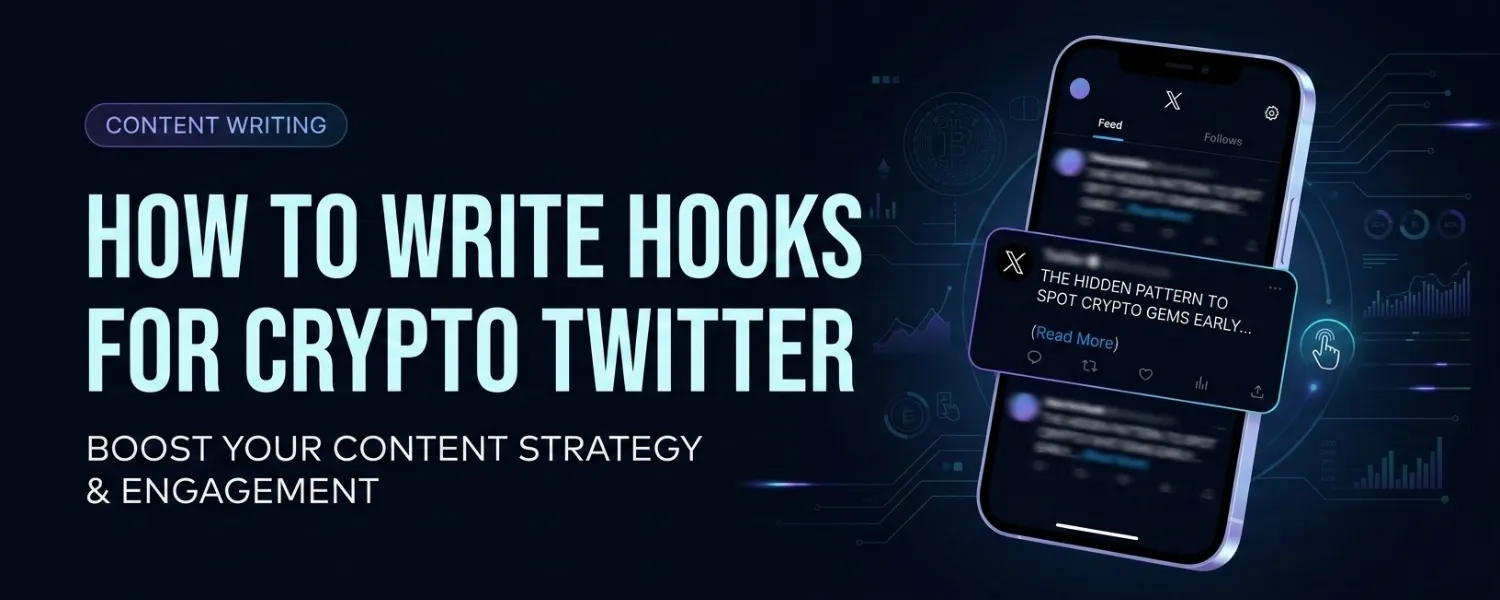
This is a complete breakdown of how hooks work, six types that perform on crypto Twitter, and a system for combining them into something readers can't ignore.
Why Hooks Matter More in 2026
The X algorithm tracks dwell time. How long someone actually looks at your post before scrolling.
A strong hook triggers a pause. That pause is a signal. The algorithm reads it as "this content is interesting to this person" and starts showing it to more people.
Your hook is also the first thing Grok's AI reads to categorize your content. It determines which audience cluster your post gets matched with. A weak, generic hook gets you vague distribution. A specific, niche hook gets you exactly the right people.
First impressions on X last 0.3 seconds. The hook is the entire first impression.
What a Hook Actually Has to Do
Three jobs. All in the first 1–2 lines.
Stop the scroll. Create a reason to read the next line. Signal clearly what kind of content this is.
Most creators only try to do the first one. They write something provocative, the reader pauses, then reads the second line and loses interest because there's no pull.
A great hook doesn't just stop the scroll. It creates a forward pull. The reader feels like they'd be missing something if they left.
6 Hook Types for Crypto Twitter
The 6 Hook Types That Work on Crypto Twitter
Type 1: The Data Hook
Open with a specific number that changes how the reader sees something they already care about.
Why it works: Numbers create instant credibility. They also create curiosity gaps. The reader wants to know what those numbers mean for them.
Examples:
The number has to be specific. "Many people" or "most creators" tells the reader nothing. "847 accounts" or "64 out of 100" gives them something real to hold onto.
Type 2: The Insider Knowledge Hook
Promise information that most people in the space don't have access to.
Why it works: Web3 audiences are alpha-hunters by nature. The promise of exclusive insight is irresistible. But the insider claim has to feel earned and authentic.
Examples:
Fake exclusivity. If the "insider knowledge" turns out to be generic, the reader won't trust you again. This hook only works if the content actually delivers something non-obvious.
Type 3: The Contrarian Hook
Take a position against a widely accepted belief in your niche. Then back it with data or experience.
Why it works: Agreement is boring. Disagreement creates tension. Tension creates attention. CT is full of people waiting to be told they've been doing something wrong.
Examples:
The contrarian hook only works with evidence behind it. A hot take with no substance gets dismissed instantly. A contrarian claim with data gets bookmarked.
Type 4: The Curiosity Gap Hook
Open with something incomplete. Give the reader just enough to need the answer.
Why it works: The brain hates unresolved questions. Once the gap is opened, the reader feels genuine discomfort leaving it open. They read on to close it.
Examples:
The key: tease the answer without giving it. The gap has to feel worth closing. If the payoff is weak, the reader feels tricked.
Type 5: The Stakes Hook
Show the reader what they're losing by not having this information.
Why it works: Loss aversion is twice as powerful as gain framing. Showing someone what they're missing creates urgency that "here's how to improve" never does.
Examples:
The stakes have to be real and believable. Exaggerated stakes feel like manipulation. Precise, specific stakes feel like a wake-up call.
Type 6: The Personal Story Hook
Open with a real moment from your own experience. Specific enough to feel genuine.
Why it works: Stories create instant relatability. When the reader sees themselves in your situation, they lean in. In Web3, where trust is scarce, a vulnerable personal opening is one of the fastest ways to earn attention.
Examples:
The story has to be real. Crypto audiences are extremely good at detecting manufactured vulnerability. Authenticity is the asset here.
Multi-Layer Hooks: How to Combine Types
A single-layer hook is average. A multi-layer hook is hard to ignore.
The strongest hooks combine two or three elements from the types above. Here's the difference:
Single layer (weak): "Here are 5 tips for growing on X."
Multi-layer (strong): "I analyzed 1K accounts. 89% share one pattern. Miss it and you're invisible on X."
That second hook combines: Data + Curiosity + Stakes. Three layers in one sentence.
Multi-Layer Hook Builder
Proven combinations that work for Web3:
| Combination | Example structure |
|---|---|
| Data + Curiosity | "I analyzed [N] [things]. [X]% share one pattern nobody talks about." |
| Identity + Promise | "If you've been creating in Web3 for 1+ year and still guessing the algorithm..." |
| Contrarian + Stakes | "Everything you know about posting frequency is wrong. It's costing you daily." |
| Transformation + Specifics | "3 months ago: 800 followers, 50 impressions. Today: 12K, posts hitting 10K+. The exact change ↓" |
| Curiosity + Social Currency | "The signal smart accounts noticed 3 weeks before everyone else." |
The goal: each layer adds a reason to keep reading. Stack them and the pull becomes almost unavoidable.
10 Templates to Use Right Now
These are structures. Fill in the brackets with your specific content.
- "I analyzed [N] [subject]. [X]% share one pattern. Here's what I found."
- "Here's what nobody's talking about with [recent event/update]."
- "[Popular belief] is wrong. I tested it for [timeframe]. Here's the data."
- "I changed one thing about [process]. [Specific result] in [timeframe]."
- "If you've been [doing X] for [time] and [not seeing Y], read this."
- "[Specific number] that changes how you think about [topic]."
- "Something happened to [metric] in [month]. Took me [time] to figure out why."
- "[Topic] just changed. Most people missed what actually matters. Let me explain ↓"
- "Every [successful example] shares this pattern. [X]% of creators skip it."
- "I made a mistake with [thing]. Here's what it cost me and what I changed."
Fill in with your own numbers, your own experience, your own niche. These are containers. The specifics are what make them work.
What Kills a Hook
"I think this might be useful" or "this could potentially help you" signals low confidence. The algorithm's ranking model correlates confidence with content quality. Readers do the same instinctively.
Delete every hedge. State things directly. If you're not sure enough to be direct, the content isn't ready to publish.
These openings make no promise. They give the reader no reason to pause:
- "Today I want to share something important about content creation."
- "Here's a quick thread about the X algorithm."
- "Something I've been thinking about lately..."
Skip the setup. Start with the thing itself.
"Ever wonder why some posts go viral and others don't? Of course you have." - The rhetorical question that answers itself is one of the most overused structures in content creation. Readers recognize it immediately and scroll past.
Ask questions that have non-obvious answers. Or skip the question entirely and just state the finding.
The One Rule That Covers Everything
Every hook has one job: make the next line impossible to skip.
Read your hook. Then ask: does someone who's mildly interested in this topic feel pulled to the next sentence? If the answer is anything less than yes, rewrite the hook.
The rest of the post can be outstanding. The best copywriting framework from Part 1 of this series. A genuinely useful insight. Real data from your own work.
None of it matters if the hook doesn't hold.
Pick one hook type. Write your next post with it deliberately. Then watch the first 30 minutes of reach. Reply to @pawnie_ with your hook - I'll give you honest feedback.
What's Next in This Series
This is Article 2 of the Web3 Creator Playbook - a complete guide to content creation on X for crypto creators.
Web3 Creator Playbook
- Part 1: The Copywriting Frameworks Every Web3 Creator Needs
- Part 2: How to Write Hooks That Stop the Scroll on Crypto Twitter (this article)
- Part 3: How to Write Crypto Twitter Threads That People Actually Finish
- Part 4: Storytelling for Web3 Creators: Build a Personal Brand That People Trust
- Part 5–10: Viral Mechanics, Engagement, AI Tools, Calendar, Ideas, Pillar — coming soon
Follow @pawnie_ on X to get each article as it drops. Or check the full series at web3lists.com/blog.